From the blog
Invisalign vs. Braces: A Straightforward Comparison for Adults
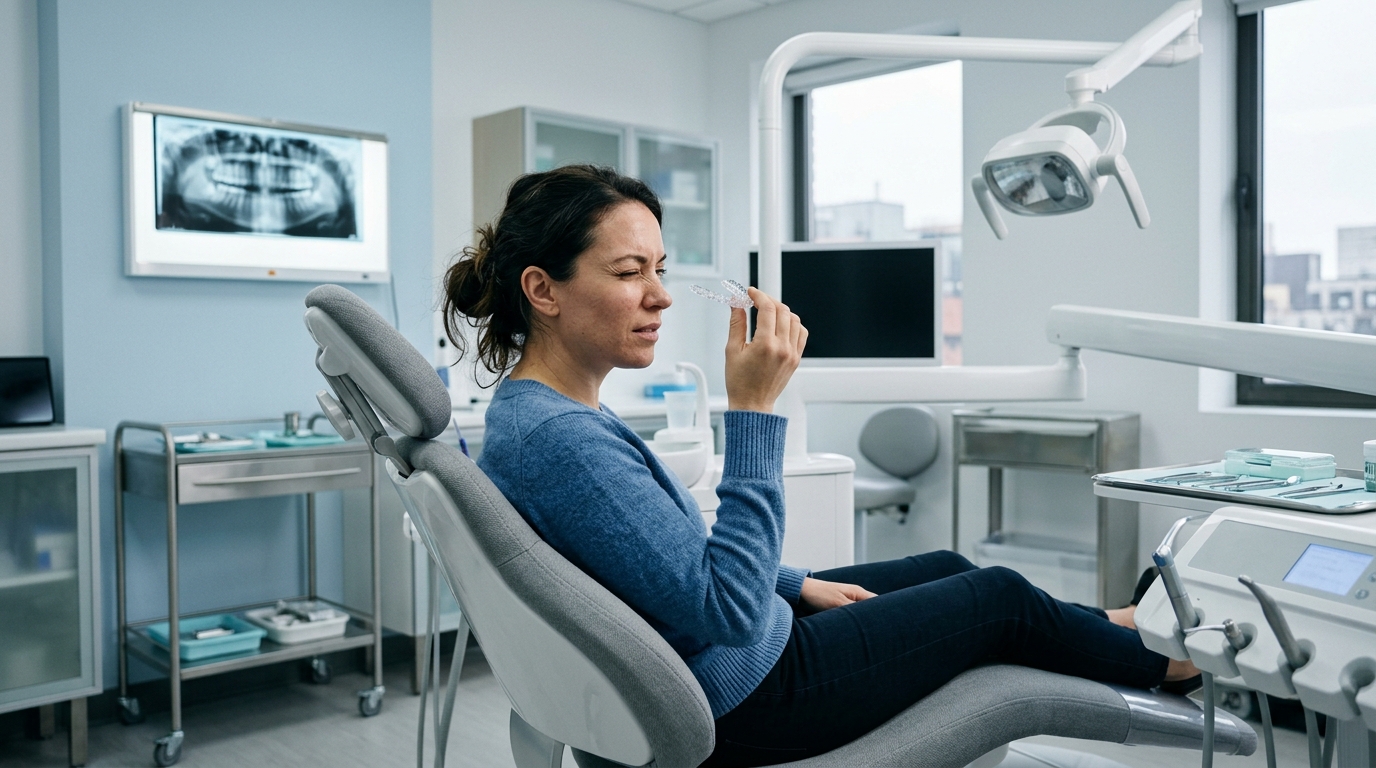
Invisalign clear aligners and traditional metal braces both straighten teeth effectively, but they differ dramatically in comfort, visibility, cost, and treatment timeline. For most adults with mild-to-moderate misalignment, Invisalign delivers comparable results with less lifestyle disruption. For complex cases - severe crowding, significant bite correction, or rotational movement - traditional braces remain the more powerful and reliable tool.
Here's everything you need to make a confident, informed decision before you walk into your orthodontist's office.
How Each System Works
Traditional braces use metal brackets bonded directly to each tooth, connected by an archwire that your orthodontist tightens at regular intervals - typically every 4 to 8 weeks. The constant pressure gradually shifts teeth into alignment. Ceramic braces work on the same principle but use tooth-colored brackets for a subtler look.
Invisalign uses a series of custom-molded, BPA-free thermoplastic aligners (made from Invisalign's proprietary SmartTrack material). You swap to a new tray roughly every 1 to 2 weeks, wearing each set for 20 to 22 hours per day. Attachments - small tooth-colored bumps bonded to teeth - are often added to give the aligners more leverage on difficult movements.
Side-by-Side Comparison: Invisalign vs. Braces
Factor Invisalign Traditional Braces Visibility Nearly invisible Clearly visible (metal); subtle (ceramic) Average Treatment Time 12–18 months (mild/moderate cases) 18–24 months (all case types) Typical Cost Range $3,500–$8,500 $2,500–$7,500 Removable Yes No Dietary Restrictions None (remove to eat) Significant (no hard, sticky, or chewy foods) Oral Hygiene Easy - brush and floss normally Difficult - requires special flossing tools Discomfort Level Mild pressure with new trays More soreness after tightening; bracket irritation Complex Cases Limited effectiveness Handles severe cases well Compliance Required High - must wear 22 hrs/day Low - fixed, no discipline needed Office Visits Every 6–10 weeks Every 4–8 weeksCost: What Adults Actually Pay in 2026
Cost is often the deciding factor, and the gap between Invisalign and braces has narrowed considerably. Invisalign runs $3,500 to $8,500 depending on case complexity and your geographic market. Traditional metal braces fall between $2,500 and $7,500. Ceramic braces sit closer to the Invisalign range at $4,000–$8,000.
Most dental insurance plans with orthodontic coverage pay a lifetime maximum of $1,000–$2,500, and the majority of plans now cover Invisalign at the same rate as braces - verify your specific policy before assuming otherwise. Both options are FSA- and HSA-eligible, which can effectively reduce your out-of-pocket cost by 20–37% depending on your tax bracket. Nearly every orthodontic practice offers 0% financing for 12–24 months.
Who Should Choose Invisalign
- Professionals and public-facing adults who need to maintain a polished appearance throughout treatment
- Adults with mild-to-moderate crowding, spacing, or minor bite issues
- People with gum sensitivity who want to avoid metal irritation
- Anyone committed to consistent daily compliance- wearing aligners 20–22 hours is non-negotiable
- Adults who travel frequently and prefer fewer in-office appointments
Who Should Choose Traditional Braces
- Adults with severe crowding, large gaps, or complex bite problems (overbite, underbite, crossbite)
- People who are concerned they won't maintain the discipline of wearing aligners consistently
- Patients seeking the lowest possible cost option
- Anyone requiring significant tooth rotation or vertical movement, which braces handle more efficiently
- Adults with certain dental restorations (bridges, some implants) that prevent aligner attachment use
The Compliance Reality of Invisalign
This point deserves direct emphasis: Invisalign only works if you wear the aligners. The 20-to-22-hour daily requirement is not a suggestion. Removing aligners to eat and drink (anything other than water), then immediately reinserting them, is the discipline the system demands. Adults who travel, attend frequent social events, or find themselves consistently "forgetting" to reinsert trays will see extended timelines and compromised results.
A 2024 clinical review published in the American Journal of Orthodontics and Dentofacial Orthopedics found that actual aligner wear time among self-reporting adult patients averaged 17.8 hours per day - meaningfully below the prescribed minimum. If that sounds like you, braces remove the variable entirely.
Effectiveness for Complex Cases
Invisalign has significantly improved its capabilities over the past decade. Invisalign's G8 and subsequent algorithm updates improved control over tooth movement, particularly for open bites and deep overbites. However, severe skeletal discrepancies, large rotations (greater than 20 degrees), and cases requiring extractions are still better handled with braces, often in combination with other appliances.
The right answer here isn't about brand preference - it's about your specific clinical picture. An experienced orthodontist will show you a digital treatment simulation and explain which system gives your teeth the most direct path to the final position.
Retention After Treatment: Both Systems Require It
Neither Invisalign nor braces produce permanent results without retainers. After treatment ends, you'll wear retainers every night indefinitely - or teeth will gradually shift back. Invisalign provides Vivera retainers, which are made from the same material as the aligners. Fixed bonded retainers placed behind the front teeth are also common with both systems. Factor retainer replacement costs ($150–$500 per set) into your long-term budget.
The Bottom Line
For adults with mild-to-moderate cases who value discretion and are committed to compliance, Invisalign is an excellent choice that produces results comparable to braces. For complex cases or adults who want a set-and-forget system, traditional braces deliver more reliable control. The single most important step: consult a licensed orthodontist (not just a general dentist) who can assess your specific anatomy and recommend the option that fits your bite, lifestyle, and budget.
Invisalign Vs Braces For Adults FAQ
Is Invisalign as effective as braces for adults?
For mild-to-moderate alignment issues - crowding, spacing, minor overbites - Invisalign produces results clinically comparable to braces when worn as prescribed. For severe bite problems, large rotations, or cases requiring tooth extraction, traditional braces provide more precise mechanical control and are the more effective option.
How much does Invisalign cost compared to braces for adults in 2026?
Invisalign typically costs $3,500–$8,500, while traditional metal braces run $2,500–$7,500. Ceramic braces fall between $4,000–$8,000. Insurance orthodontic benefits (usually a $1,000–$2,500 lifetime maximum) now cover Invisalign at the same rate as braces at most major insurers. Both are FSA- and HSA-eligible expenses.
Can adults get braces or Invisalign at any age?
Yes. There is no upper age limit for orthodontic treatment. Bone density and gum health matter more than age itself. Adults with healthy gums and no active periodontal disease are strong candidates for either system. Orthodontists routinely treat patients in their 40s, 50s, and beyond with excellent outcomes.
How long does Invisalign take for adults compared to braces?
Invisalign treatment for adults typically runs 12–18 months for mild-to-moderate cases. Traditional braces average 18–24 months across all case types. However, complex cases with Invisalign can extend to 24+ months, and straightforward braces cases can finish in under 18 months. Your specific treatment plan timeline is the only number that matters.
What happens if I don't wear my Invisalign aligners enough?
Consistent under-wearing - averaging fewer than 20 hours per day - causes teeth to not track with the planned movement, forcing refinement trays (additional aligner series) and extending your total treatment time. In some cases, the orthodontist will need to pause treatment and reassess. Extended gaps between aligner wear can also cause aligners to no longer fit properly.


